
Strategy — YouTube is the factory
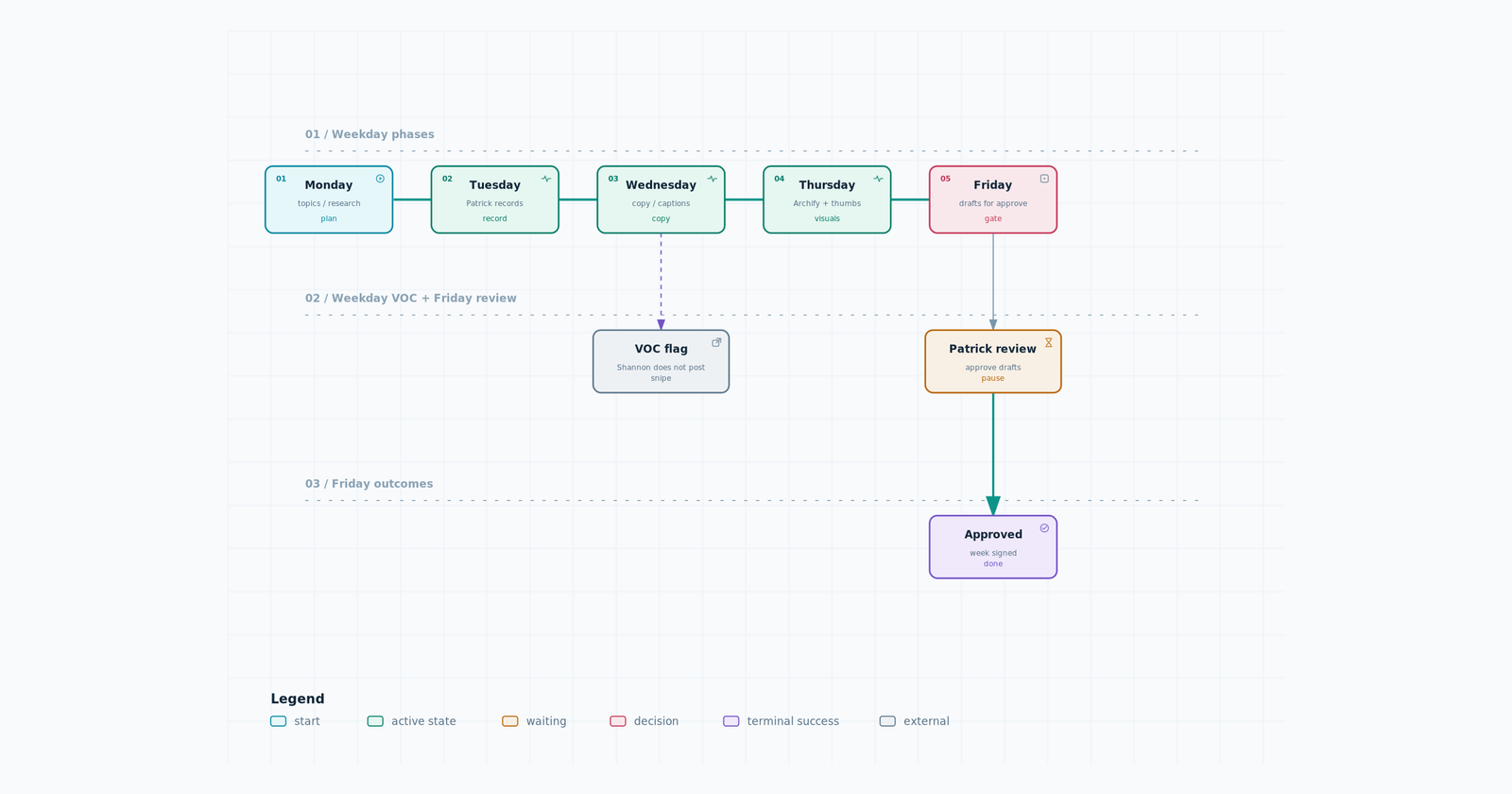
Factory strip — three long-forms — then cut/package
JD teardown
Public posting. Company unnamed. Score chase vs judgment. 12-15 min. Promise in 20s.
Talking head / demo
Same desk. Archify path: intake to watchers to daily list to human ack to write-back.
ICP podcast
Booked guest. Talking-head substitute if no guest. Not a fake interview.
One screen. Hold this.
Three long-forms a week. One role theme. Patrick records. You cut, package, and queue drafts from those three. That is the whole motion.
The three episodes
- Ep1 — JD teardown. 12-15 min. A real public posting, company unnamed. Score chase vs judgment.
- Ep2 — talking head / demo. Same desk. The path on screen (Archify): intake → watchers → daily exception list → human ack → write-back.
- Ep3 — ICP podcast. Booked guest. Talking-head substitute only if there is no guest. Not a fake interview.
Then 6-10 shorts from those three. Then X and LinkedIn drafts from the same beats. Not a second topic mill.
Who does what (one line)
| Patrick | You | |
|---|---|---|
| Records | Focus C. Packet on desk. Sends the file. | Do not invent a recorder. |
| Packages | Approves. | Titles, AEO description, chapters, thumbs, Archify, shorts, native captions, X + LinkedIn drafts. |
| Posts / DMs / books / pays | Only him. | Never. |
| Watches | You ping him only on a real hit. | Topics, hooks, formats, profile visits, follows, map requests. |
If a week would go dark, shrink to Ep1 plus shorts. Do not invent a guest. Do not ship silence if Ep1 can run.
Pass bar
you can say the factory out loud in 20 seconds. Three long-forms. Cut from those. He records. You draft. He approves.
0. Company lock + claim guard
Why this exists
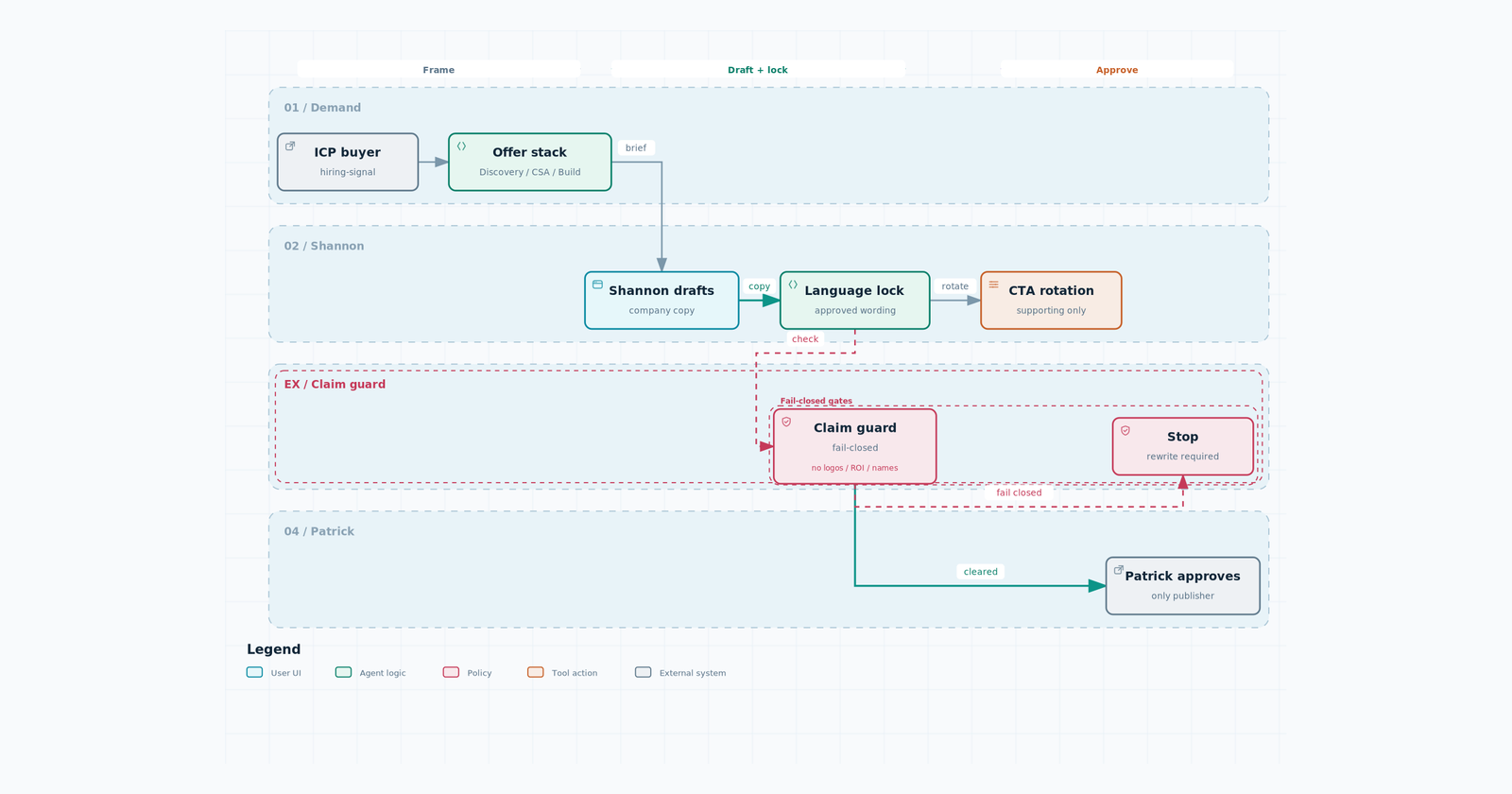
Everything public fails closed on this page. If the lock is wrong, the packet is wrong, the cut is wrong, the caption is wrong.
You are non-client-facing. Quality of prep, not revenue. You make Patrick faster.
Trigger-led outbound QC is a later lane. One line at the end of this pack. Do not hunt accounts, draft DMs, or QC outbound batches until he opens that lane.
Work steps
- 01
Read What we sell, How we sell, Language, CTA, Fail closed, Your lane. Write the three Friday answers.
- 02
Before any draft leaves your desk, run Claim guard. Quote failing lines. Do not "fix quietly" and ship.
- 03
If you cannot anonymize a posting, pick a different public JD. Do not name a live hiring company the same week.
- 04
Rotate the CTA. Never skip. Never dump the 20-minute discovery calendar on every post.
- 05
RecStack and SearchNOW stay off First Article work.
What we sell
Operational AI for industrial and project-based companies in the US and Canada (supported revenue over $10M). Manufacturing, construction/fabrication, energy and field service, industrial services, logistics. Buyer is C-suite / VP / director over the function.
Product is Your Company GPT plus connected agents that live in the tools they already use. Not a new dashboard.
Beachhead: coordinator work that is mostly chase (procurement coordinator, expediter, logistics coordinator).
Positioning, always: Win more work. Move it faster. Deliver on time.
How we sell
20-minute discovery → $3,500 Current State Assessment (credited toward build) → custom implementation starting at $35k over 90-120 days. Then Managed AI Systems ($5k/month) or Embedded AI Engineer ($18-25k/month).
Public content does not dump that price list unless Patrick put it in the script.
Language
Customer pain: unconfirmed POs, late dates, inbox/spreadsheet chase. Not internal offer copy. Not "AI strategy." Not chatbot-agency.
CTA on Patrick's posts (rotate, never skip)
- An engagement question tied to that post
- The role-automation map
- The $1,500 / 90-minute workshop (founder angle, not operator angle)
Not a calendar dump of the 20-minute discovery on every post.
Fail closed
- No named customers, logos, or live outbound accounts in public content
- No invented ROI, guarantees, or "we automated X at Company Y"
- Do not call a YouTube video a Current State Assessment
- Do not generate Patrick's face or the logo. Use the approved wordmark file only
- Do not send DMs, publish, book, or pay. Draft, then Patrick
- RecStack and SearchNOW stay off First Article work
Claim guard (run on every draft)
Fail the draft if any of these are true:
- A live hiring company or outbound account is named in public content
- A video is called a Current State Assessment, audit, or paid analog
- ROI promise, invented metric, or guarantee
- Pricing or offer changed without Patrick
- RecStack / SearchNOW mixed in
- Naked calendar CTA unless Patrick asked for it
- Agent awards vendors, sets price, or promises the customer
- Generated face or typeset logo
- A diagram names a customer, shows a fake ROI, or hides the approval step
Return pass/fail with the failing lines quoted.
Your lane
Non-client-facing. Quality of prep, not revenue. Research, packets, copy, thumbnails, edits, packaging, performance notes.
Pass bar
Pass bar
He can quiz you on buyer, offer, three fails, and CTA rotation without you flipping pages. A draft with a named live account, a generated face, or "agent approves the PO" is a fail. You quote the line.
What good looks like
C-suite / VP / director over ops or procurement at a US/Canada industrial firm. They hire us to put agents in the tools they already use so chase work moves and judgment stays human.
Named hiring company in a public teardown the same week. Calling the video a Current State Assessment. Generated Patrick face on a thumb.
YouTube description: soft CTA from the rotation, no price list unless it was in the script. LinkedIn: engagement question, or the map, or the $1,500 workshop. Never a naked calendar dump of the 20-minute discovery.
What not-good looks like
Calling the video a Current State Assessment. Generated Patrick face on a thumb. Live hiring-company name in a public teardown the same week. Agent "approves the PO."
"Book your $3,500 Current State Assessment this week — we automated Acme Fabrication." Named company. Price list. Fake proof.
Shannon exercise
Shannon exercise
Write answers to the three Friday questions. Then take one line you almost wrote and run claim guard on it. Quote the fail if there is one.
Friday questions (write answers)
- In one sentence, who is the buyer and what do they hire us to do?
- Name three things that would fail a draft.
- What is the CTA on a YouTube description vs a LinkedIn post?
1. The factory / week motion
Why this exists
You run a factory, not a content lottery. One role theme. Three long-forms. Everything else is generated from those three.
X and LinkedIn are not a second factory. Posts come from episode beats. You do not run a separate 7-10-topic mill.
Work steps
- 01
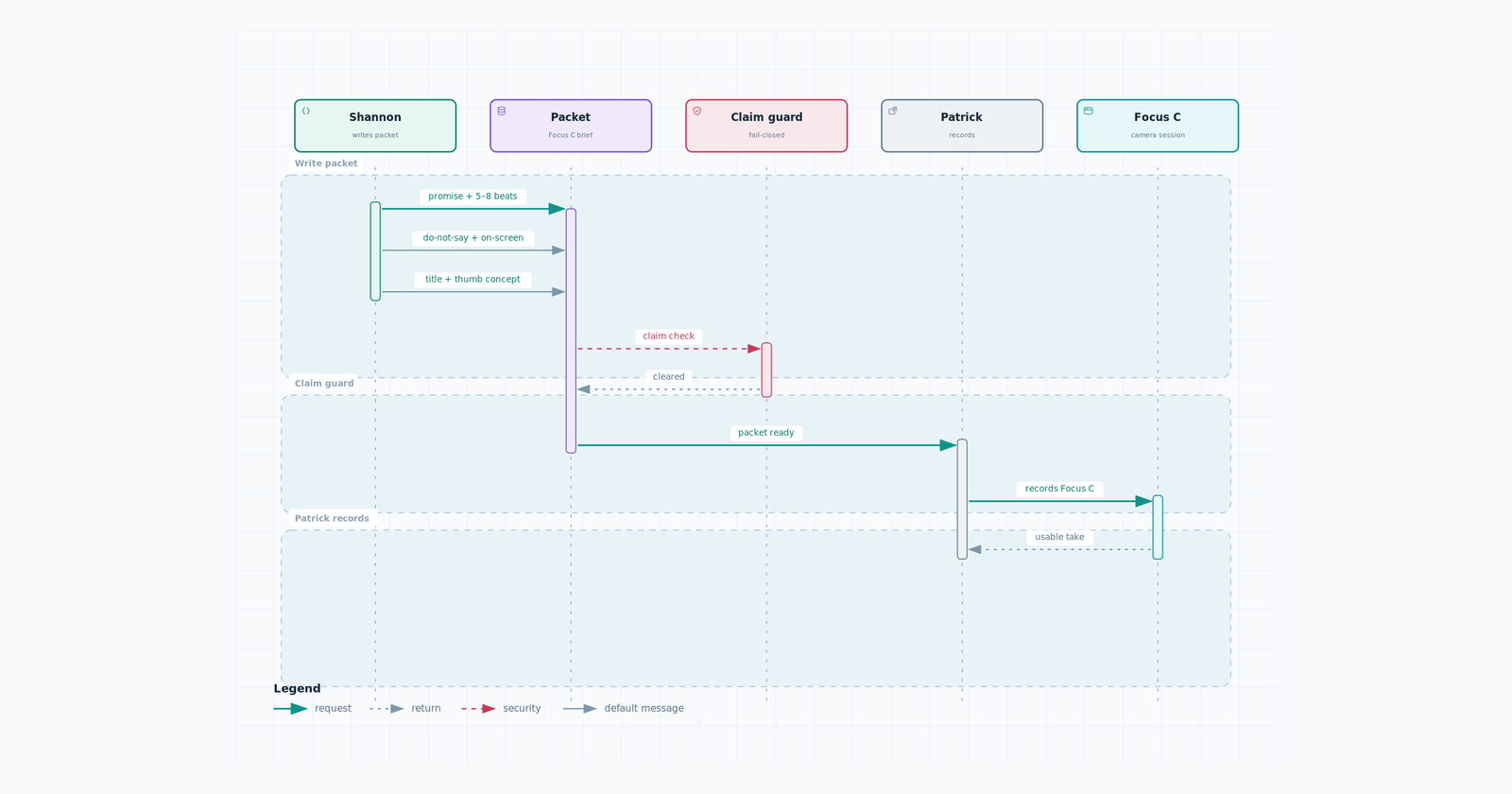
Packet on his desk (promise, beats, do-not-say, on-screen, title, thumb).
- 02
He records in Focus C. He sends the file.
- 03
You write the edit brief, then you cut.
- 04
You package: titles, AEO description, chapters, thumbnail.
- 05
You cut 6-10 shorts from the three long-forms.
- 06
You write native captions for YouTube Shorts, X, and LinkedIn. (Instagram and Facebook exist later. This pack names those three.)
- 07
You turn episode beats into X and LinkedIn drafts. Same ideas, different containers. See Module 6.
- 08
He approves. Nothing posts until he does.
- 09
You watch what moved. You ping him only on a real hit.
Draft, then approve. That is the whole company rule.
Weekly shape (one role theme)
- Ep1 — anonymized job-description teardown. 12-15 min. First 20 seconds = the promise.
- Ep2 — talking head / demo of the system behind that role. Archify on screen. Never a named-company CSA.
- Ep3 — podcast with an ICP leader / decision-maker. Talking-head substitute only if there is no guest.
Then 6-10 shorts → YouTube Shorts, X, LinkedIn.
If a week would go dark, shrink to Ep1 plus shorts. Do not invent a guest.
Who does what
| Step | You | Patrick |
|---|---|---|
| Pick the week's role theme | Research public JDs / ICP pain. Propose. | Locks the theme |
| Recording packet | Write it. Claim-guard it. | Records from it. Does not write it |
| Focus C | Do not invent a new recorder | Records. Sends the file |
| Edit | Brief, then cut. Diffusion when on | Approves the cut |
| Thumbnails | FAL art + real still. Never his face | Approves the frame |
| Archify (Ep2) | Diagram, HTML + PNG | Approves before it is on screen |
| Shorts + captions | 6-10, native copy | Approves |
| X + LinkedIn | Drafts from episode beats. Flag snipes | Quotes snipes. Approves. Posts |
| Guest outreach | After a yes: research card, questions, host packet | Guest bot finds. Codex writes outreach. He sends |
| Publish / DM / book / pay | Never | Only him |
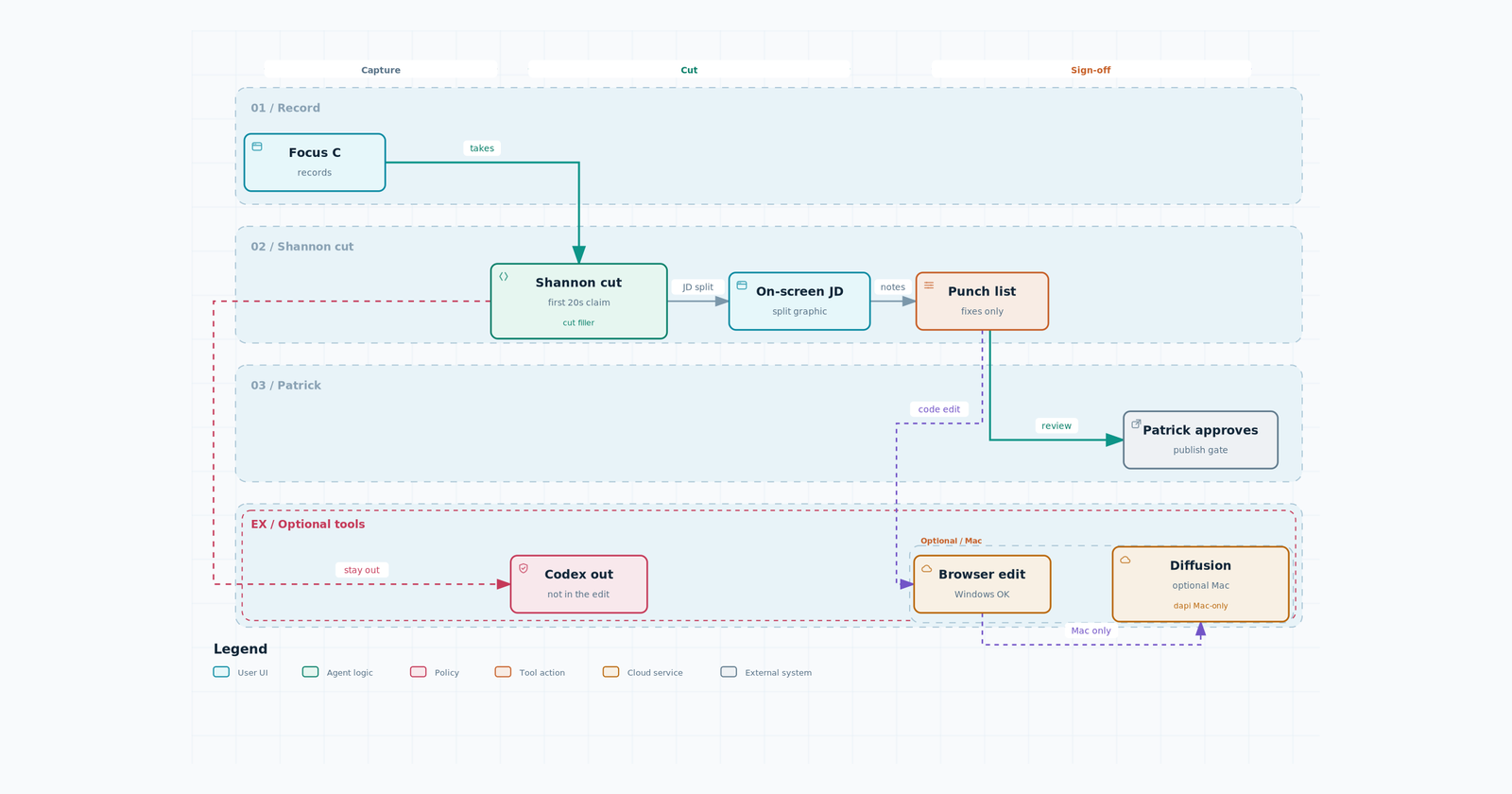
Codex stays out of the edit. Hyperframes is motion and thumbnail stills, not the recorder.
Snipes are the rest of the week, not the week. You flag a live conversation on a weekday VOC / competitor watch. He quotes. You never post the snipe. Mon-Fri only unless he adds a weekend.
Pass bar
Pass bar
He can sit down in Focus C without inventing a beat. You can cut without guessing the promise. Nothing public until he says so. Posts on X and LinkedIn trace back to this week's episodes, not a blank topic list.
What good looks like
Theme is procurement coordinator chase. Ep1 scores a public JD. Ep2 walks the chase loop on an Archify path. Ep3 is a guest or a talking-head substitute. Shorts and posts come from those beats.
Guest fell through. Ep1 still runs. Shorts still cut. Ep3 is a talking-head substitute on the same desk. No fake interview. No dark week.
Tuesday X draft lifts Ep1 beat 6: "It does not approve the PO." Not a seventh topic you invented on a whiteboard.
What not-good looks like
Monday: "here are 9 unrelated topics for the week." Posts that never appeared in a packet. A 7-10-topic mill beside YouTube.
No Ep1 because the guest said no. Or a fake two-chair interview with nobody sitting in the other chair.
Shannon exercise
Shannon exercise
Write this week's factory on one index card: role theme, Ep1 source (public JD type, company unnamed), Ep2 path in five words, Ep3 guest-or-substitute. Show where the first X post will come from.
2. Her day-to-day (work instruction)
Lock
His deskTheme + packet start
You returnTheme locked or a no
Record
His deskFinished Ep1 packet
You returnFocus C file when he sends it
Cut
His deskNext packet. Punch list if a cut exists
You returnNo invented cut
Queue
His deskEp3 packet, thumbs, table
You returnQuoted fails
Approve
His deskThe pack
You returnApproved / needs-fix. You still do not post
Why this exists
Strategy is the factory. This is the week on a clock. Hour-ish blocks. What sits on Patrick's desk. What you return.
Mon-Fri. No Saturday/Sunday content job unless he adds one. If footage is late, do not invent cuts. Advance packets, copy, thumbs, and diagrams. Shrink the public week to whatever he actually recorded.
Work steps (the week)
Use the timeline. Same motion every week. Times are blocks, not a punch clock.
Monday — lock and packets
- 01
Block A. Lock the week's role theme. Pick the public Ep1 JD. Anonymize. If it is also in the outbound folder, strip every identifier or pick a different JD.
- 02
Block B. Draft Ep1 packet first (promise, 5-8 beats, do-not-say, board, title, thumb concept). Start Ep2/Ep3 packets from that same desk.
- 03
Block C. First X + LinkedIn atomic from those beats. Flag zero or one snipe from weekday watch, or write "none this week."
- 04
On his desk: theme proposal + Ep1 packet start + snipe-or-none.
- 05
You return: theme locked (or a no, and you pick another JD).
Tuesday — Ep1 on desk, he records
- Block A. Finish Ep1 packet. Put it on his desk before he sits down in Focus C.
- Block B. Keep writing Ep2. Archify in progress. Captions from Ep1 beats.
- On his desk: finished Ep1 packet.
- He does: records Focus C from the packet. Sends the file.
- You return: the file when he sends it. Do not chase a second recorder.
Wednesday — cut what exists, finish Ep2
- Block A. If the file is in: edit brief first, then cut. If the file is not in: do not invent a cut. Advance Ep2 packet + diagram.
- Block B. Shorts from that file when it exists. Native X/LI from those beats.
- Block C. Ep2 packet + Archify toward done.
- On his desk: next packet when it is actually ready. Punch list if a cut exists.
- He does: records the next episode when the next packet is ready.
Thursday — Ep3, thumbs, queue
- Block A. Ep3 host packet (after a yes) or talking-head substitute packet. Do not hunt guests.
- Block B. Thumbs: FAL art, real still, never his face. Live-channel template.
- Block C. Queue remaining drafts. Claim-guard the pack.
- On his desk: Ep3 packet, thumb comps, claim-guard table.
- He does: records remaining. Reviews early drafts if he wants.
Friday — full pack, he approves
- Block A. Full week pack queued: cuts, shorts, captions, X/LI, thumbs, diagrams.
- Block B. Claim-guard table. Performance note only if something actually moved.
- On his desk: the pack. Pass/fail with quoted lines.
- He does: approves. Nothing publishes without him.
- You return: approved / needs-fix list. You still do not post.
Snipes get flagged on the same weekday watches. Not a weekend job.
Pass bar
Pass bar
A packet is on his desk before he records. You can point at each block and say what sits on his desk and what you return. Friday pack is claim-guarded. You did not post.
What good looks like
Ep1 packet is one page. Promise is the first 20 seconds. Do-not-say is filled. Board is scored. He does not invent a beat in Focus C.
No fake cut. Ep2 Archify still moves. Captions marked "practice from beats, not a cut." Public week shrinks to what he recorded.
Queue + claim-guard table. Failing line quoted. Performance note only if a map was asked for, an ICP executive engaged, or a guest said yes.
What not-good looks like
He sits down in Focus C. No packet. You are "still researching." He invents beats. You guess the promise in the edit.
Saturday queue of snipes. You post one because he was slow. First line of the quote is "Great point!"
Shannon exercise
Shannon exercise
Print the Mon-Fri timeline. For this week, fill: Block A/B/C in one line each, what sits on his desk, what you return. Mark any block that is blocked and why. Do not wait on a bot. Bring the blocker to the 15-minute check-in.
3. Ep1 — JD teardown
Why this exists
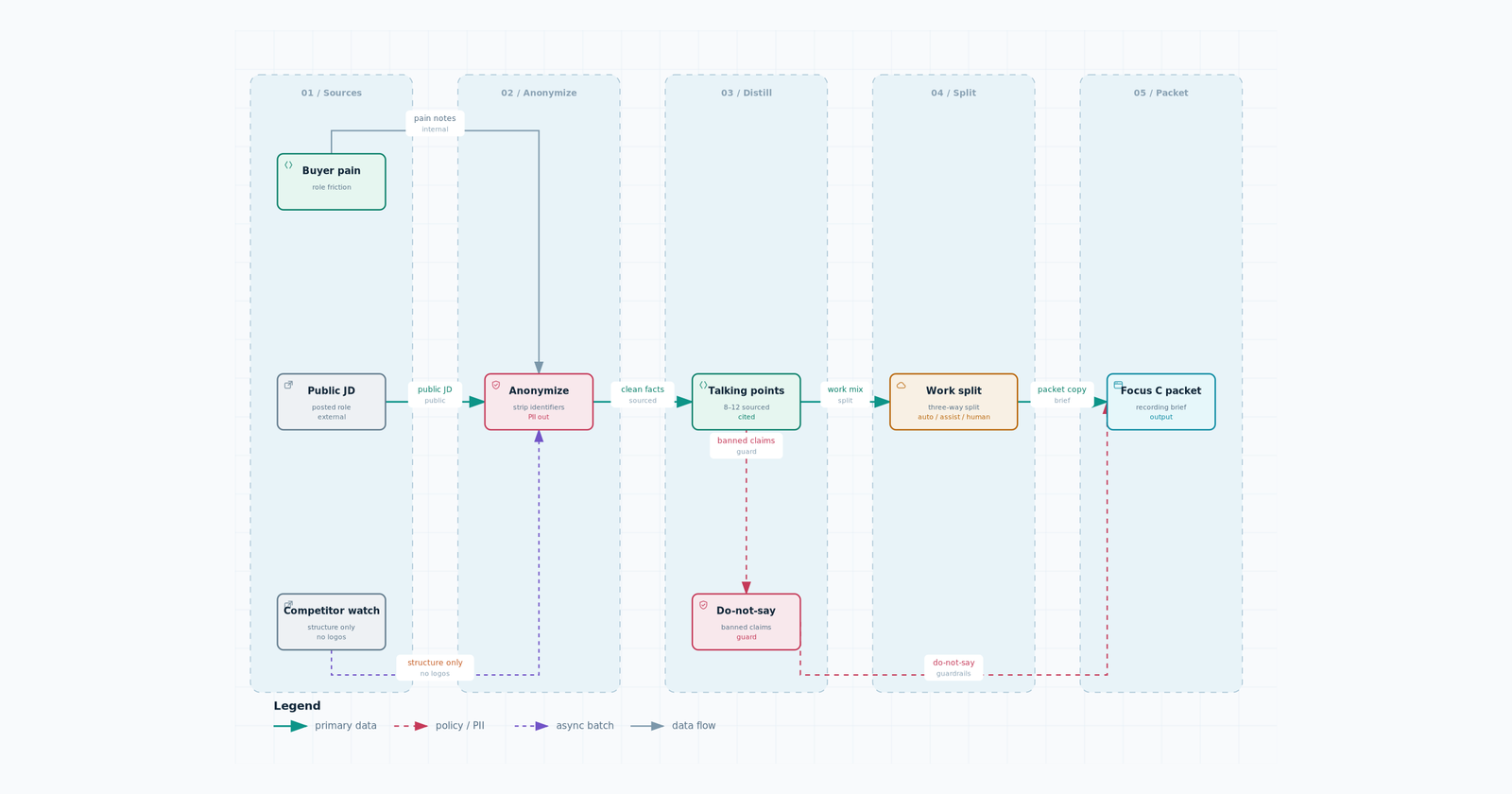
Show a real coordinator-type desk as it actually runs. Score the work. Separate chase from judgment. Leave the buyer with a board they can argue with, not a slogan.
12-15 minutes. First 20 seconds = the promise on screen and in his mouth.
This is not a tour of a named shop. This is not a Current State Assessment.
Work steps
- 01
Pick one role theme for the week. Ep1 is the public posting that makes that desk visible.
- 02
Source: public ICP job descriptions. Procurement coordinator, expediter, logistics coordinator, or the cousin seat that is mostly chase.
- 03
Check the posting: US or Canada industrial / project-based, established. Not a two-person shop. The posting is chase: unconfirmed POs, late dates, inbox/spreadsheet follow-up. Not culture/HR.
- 04
Confirm you can score every duty automate / assist / human without guessing their ERP.
- 05
Anonymize. Company unnamed. No city, wage, or unique project that IDs them. Never name a live outbound account in public the same week. If the posting is also in the outbound folder, strip every identifier and treat it as a role type. If you cannot strip it, pick a different public JD.
- 06
Write the recording packet (template below). Claim-guard it.
- 07
Put it on his desk. Do not copy last week's packet. Build from this week's posting.
How ideas are chosen
One role theme. One public posting. Duty-weighted read of this posting, not a time study, not a guaranteed percentage.
Copy / framework (every Ep1)
- Promise. What they can score or see when it ends.
- The job as it actually runs. Chase, not org-chart poetry.
- Score the board. Automate / assist / human, line by line, out loud.
- The split. How much is chase vs judgment. Duty-weighted read of this posting, not a time study, not a guaranteed percentage.
- Agent shape. Lives in email, ERP, spreadsheet. Not a new app.
- Hard no. It does not award vendors, change price, or promise the customer a date.
- What this is not. Not their shop. Not a paid assessment. Company unnamed.
- CTA from the rotation.
First 20 seconds carry the promise. Kill throat-clearing.
Recording-packet template
One page. He talks. You write the frame.
- Promise — one sentence. What they can score when it ends.
- 5-8 spoken beats — cold open (20s, promise), desk as it runs, score the board, split, agent shape, hard no, close. Timed enough that 12-15 min is real.
- Do-not-say — company name, cities, wage; CSA / audit / case study; RecStack / SearchNOW; guarantees, hours saved, ROI; FAS price list; ERP names they did not publish; naked calendar link; "we will automate your procurement."
- On-screen — the duty board. Columns: Duty / Score (automate, assist, human) / Why. Labels only. No company.
- Working title + description — five title options (~60 characters). Role or system + one concrete claim. Description: AEO question in sentence 1, then what they will see, what this is not, chapters = beats, soft CTA. See Module 6.
- Thumbnail concept — one operational claim. Live-channel template. Real still of Patrick, never generated. See Module 7.
On-screen automate / assist / human board
You build this from the posting. Every line needs a why.
| Score | Means | Example of the type |
|---|---|---|
| Automate | Deterministic chase. Agent can draft and, after ack, write | Open-PO / shortage / late reports. Daily exception digest. |
| Assist | Agent reads and flags. Human clears | Confirm quantities and dates against the ack. Draft the chase email. |
| Human | Judgment, money, or a customer promise | New vendor. Price. Award. Promise date to the customer. |
Human approval is a node, not a footnote.
Pass bar
Pass bar
He can record without inventing a beat. Company unnamed. Every duty scored with a why. First 20 seconds is the promise. Claim guard clean. This is a teaching packet for this posting, not a copy of a prior week.
What good looks like
This procurement coordinator job is 75% chase
It does not approve the PO
Issuing the PO was never the hard part. Confirming the date is.
This is a real procurement coordinator posting. I am not naming the company. I am scoring the work.
Can an agent chase unconfirmed POs without becoming the buyer?
What not-good looks like
AI Will Transform Your Procurement Forever
Case study: how we automated Acme Fabrication
Today I want to share some thoughts on operational excellence and the future of AI.
Teaching packet (filled, anonymized fabricator coordinator)
This is a teaching example. It is not "copy week-1." Do not ship it as this week's packet. Build from this week's posting.
Promise
You will be able to score this procurement-coordinator desk: which duties are chase, which are judgment, and what an agent must never do.
Beats (5-8)
- Cold open (20s). "This is a real procurement coordinator posting. I am not naming the company. I am scoring the work."
- Desk as it runs. Unconfirmed POs sit in email. The floor date is already a lie. Spreadsheet chase, not org-chart poetry.
- Score the board, line by line, out loud. Automate / assist / human. Every line has a why.
- Split. Duty-weighted read of this posting: most lines are chase. Label it that way. Not a time study. Not a guaranteed percentage.
- Agent shape. Lives in email, ERP, spreadsheet. Not a new app.
- Hard no. It does not approve the PO. It does not award, price, or promise the customer a date.
- What this is not. Not their shop. Not a paid assessment. Company unnamed.
- Close + CTA from the rotation.
Do-not-say
Company name, city, wage, unique job number. CSA / audit / case study. RecStack / SearchNOW. Guarantees, hours saved, ROI. FAS price list. ERP names they did not publish. Naked calendar link. "We will automate your procurement." Agent "approves the PO."
Board (labels only, no company)
| Duty | Score | Why |
|---|---|---|
| Open-PO / shortage / late report | Automate | Deterministic chase. Same pull every morning. |
| Daily exception digest | Automate | Same facts, one pass. Not a rebuilt spreadsheet. |
| Confirm qty and date against the ack | Assist | Agent flags mismatch. Human clears. |
| Draft the supplier chase email | Assist | Agent drafts. Named human sends. |
| Pick a new vendor | Human | Award. Money. |
| Change price | Human | Money. |
| Promise a date to the customer | Human | Customer promise. |
| Approve the PO | Human | It does not approve the PO. |
Title options (of the type)
This procurement coordinator job is 75% chase
It does not approve the PO
Issuing the PO was never the hard part. Confirming the date is.
Thumb concept
Live template. One claim: "It does not approve the PO." Real still on the right. Never generate his face.
Bad packet (do not copy this shape)
Promise: "Talk about AI." Beats: "intro, talk about AI, wrap." No do-not-say. No board. Title: "AI Will Transform Your Procurement Forever." First 20s: "Today I want to share some thoughts on operational excellence and the future of AI."
That packet fails. He would invent the episode. You would guess the promise in the edit.
Shannon exercise
Shannon exercise
Take a public procurement-coordinator (or expediter / logistics coordinator) JD. Anonymize the company. Produce the full Ep1 packet above. Score every duty. Write the first-20-seconds line he will say. Run claim guard. Do not reuse a prior week's posting as the model. Do not copy the teaching packet as week-1.
4. Ep2 — talking head / demo + Archify
Why this exists
Show the system behind that role type. Same week, same desk, now the path: intake → watchers → daily exception list → human ack → write-back.
He talks. The diagram does the showing. The demo lives in their email, ERP, or spreadsheet. Not a new app. Not a named-company CSA.
Work steps
- 01
Stay on this week's role. Ep2 is the system behind Ep1. Do not invent a second theme.
- 02
Answer who / what / when / where / why / how from this week's desk (table below).
- 03
Write the Ep2 packet on the path. Do not shuffle it.
- 04
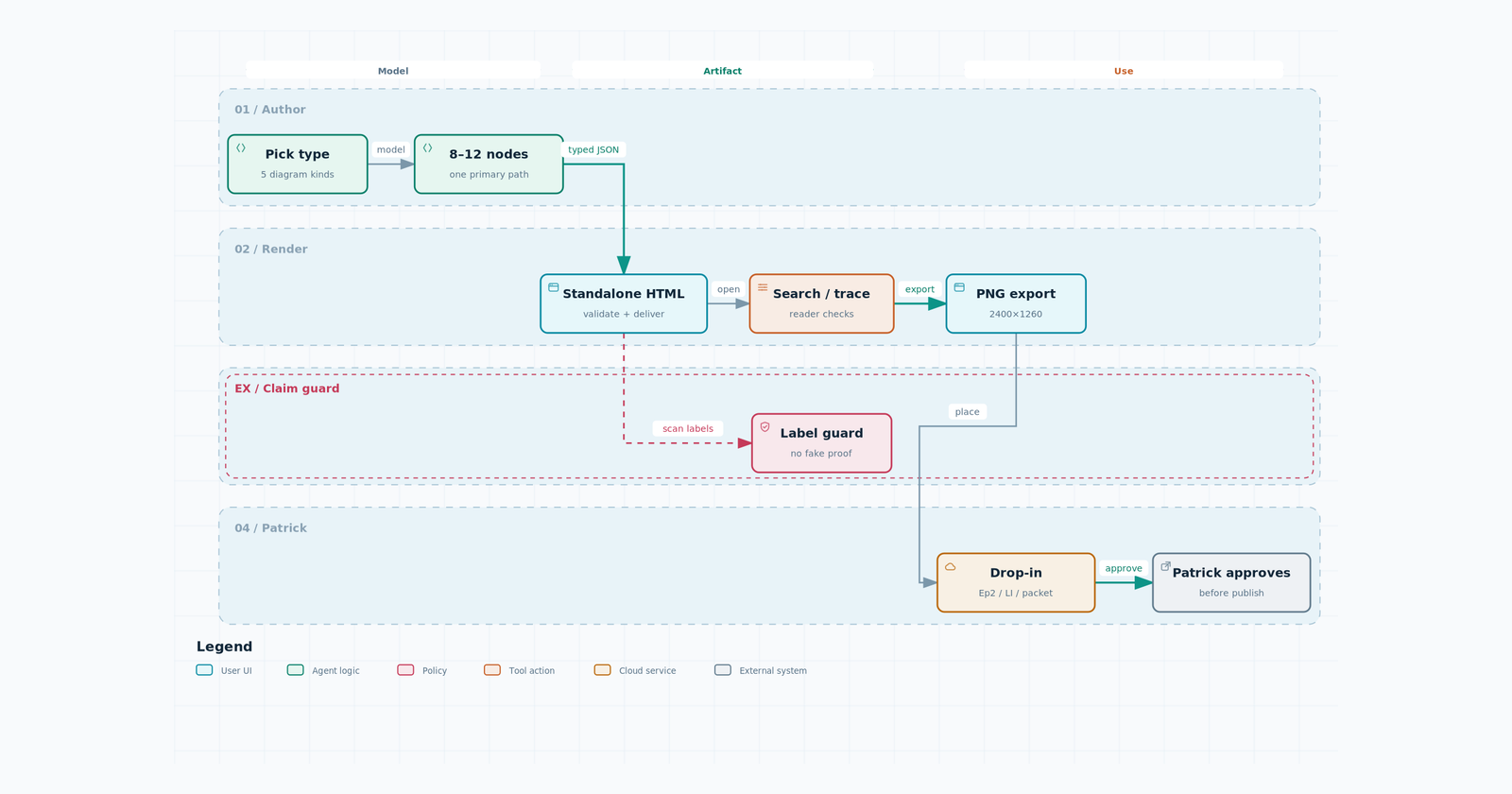
Produce the Archify diagram (HTML source, PNG 2400×1260). Human ack is a node.
- 05
Claim-guard every label. No named customer. No ROI.
- 06
Put packet + diagram on his desk. He approves the diagram before it is on screen.
How ideas are chosen (idea engine, pillar 2)
Pillar 2 is agent systems in the tools they already use. Pull topics with who / what / when / where / why / how. Stay on this week's role. Repetition with direction.
| Lens | You answer from this week's desk |
|---|---|
| Who | Who chases (coordinator) vs who awards (buyer) vs who waits (planner / floor) |
| What | What is unconfirmed, late, or typed twice |
| When | When the ack is due, when the exception list hits the desk |
| Where | Where the date lives: inbox, spreadsheet, ERP row |
| Why | Why a missed ack becomes a lie on the floor |
| How | How a watcher, a daily list, and a human ack change the path without a new dashboard |
Copy / framework (every Ep2)
Walk this path. Do not shuffle it.
- Question — one buyer question. Can an agent follow up on unconfirmed and late POs without becoming the buyer?
- Intake — open lines, acknowledgements, need-by vs promise. Where the facts enter.
- Watchers — unconfirmed, past due, at-risk. Watchers, not a dashboard they have to go look at.
- Daily exception list — only the exceptions. Same facts, one pass. Not a rebuilt spreadsheet.
- Human ack — a named human. It does not approve the PO, award a vendor, or set price.
- Write-back — after ack, the supplier's answer writes back to the ERP / the sheet they already trust.
- What this is not — not their system, not a paid engagement, not another dashboard, company unnamed.
CTA from the rotation.
Archify on screen
This is where the diagram earns the episode.
Install when Patrick has you on it: npx skills add tt-a1i/archify -g
Use Archify for:
- Ep2 on-screen path
- Packet "on-screen list" when the list is a system, not JD bullets
- A LinkedIn carousel that needs a map (Module 6). He still approves.
Not for thumbnails. Not for his face. Not for the wordmark.
Prompt template (fill the brackets):
Turn [CODEBASE / FEATURE / WORKFLOW] into a [DIAGRAM TYPE] diagram. Choose from Architecture, Workflow, Sequence, Data Flow, or Lifecycle.
Keep the 8-12 most important components and one primary path. Label external services, databases, and component connections clearly. Put supporting details in cards instead of adding more edges to the main diagram.
Generate and verify a standalone HTML file. Confirm that component search and upstream/downstream tracing work, then export a high-resolution 2400 × 1260 PNG.
Pick the type:
- Architecture — Your Company GPT + agents in their stack
- Workflow — approvals, runbooks, chase loops
- Sequence — one PO / RFQ / exception as it moves
- Data Flow — where the date, the email, the ERP row go
- Lifecycle — unconfirmed → promised → slipped → recovered
FAS lock on every diagram:
- Paper/navy, one electric-blue accent if the preset allows. Otherwise leave Archify classic and say so
- 8-12 nodes. One primary path. Cards for the rest
- No named customer. No ROI. No "we automated X"
- Human approval is a node, not a footnote
- Wordmark file only if he supplied it. Never typeset the logo. Never generate a face
- HTML is the source. PNG 2400×1260 is what goes on screen or in a post
- He approves before it ships
Recording-packet template
- Promise — they will see the path, including the human ack.
- 5-8 spoken beats — question, intake, watchers, daily list, human ack, write-back, what this is not. Match the copy framework.
- Do-not-say — CSA / audit / case study; named company; guarantees; price list; RecStack / SearchNOW; "new dashboard"; agent awards / prices / promises.
- On-screen — the Archify path (intake → watchers → daily list → human ack → write-back). Hold the diagram while he walks it. Lower-thirds: role type, not a fake company.
- Title + description — role or system + one concrete claim. AEO question in sentence 1. Chapters = the path.
- Thumbnail — one claim of the type "It does not approve the PO." Live template. Real still.
Pass bar
Pass bar
Path is unshuffled. Human ack is a node on the diagram, not a caption-only apology. HTML + 2400×1260 PNG. No customer name on a node. He can walk the diagram without inventing a step.
What good looks like
Can an agent chase unconfirmed POs without becoming the buyer?
It does not approve the PO
Eight to twelve nodes. One path. Human ack sits on the path. Company unnamed. PNG is 2400×1260.
What not-good looks like
On-screen node: "Acme Fabrication CSA." Video described as a Current State Assessment. Agent node labeled "approves the PO."
Pretty diagram. Twelve edges. No human ack. Looks like the agent awards the vendor.
Shannon exercise
Shannon exercise
From this week's Ep1 board, write the Ep2 packet. Produce one Workflow or Sequence diagram of the chase loop (email → spreadsheet → supplier → unconfirmed date → human ack → write-back). Ship HTML + 2400×1260 PNG. Run claim guard on every label. Do not put a customer name on a node.
5. Ep3 — ICP podcast
Why this exists
A conversation with an ICP leader or decision-maker about how the desk actually runs. Booked guests feed this slot. There is no podcast name, artwork, or trailer. The ask is the interview.
If there is no guest that week: talking-head substitute. Not a fake interview. Not a CSA. Not a workshop pitch.
You do not hunt guests. You do not send outreach. After a yes, you package.
Work steps
- 01
Wait for a yes. Guest bot finds. Codex writes outreach. Patrick sends. You do not hunt. You do not send.
- 02
After a yes: expand Guest's research card (do not rewrite outreach).
- 03
Write 8-12 interview questions in the desk frame. Not a product demo. Not a CSA. Not a workshop pitch.
- 04
Write the host packet, one page. Put the exact referral line in it so he actually says it.
- 05
If there is no guest: write the talking-head substitute packet for this week's role. He is not pretending to be a guest.
- 06
Claim-guard. Put it on his desk.
How ideas are chosen
Guest bot runs the Shulman loop. You do not hunt guests. You do not send outreach.
What Guest does (so you know the rail):
- Find interesting ICP people with ~800-2,000 followers (yes-rate band, not the identity). Growing list, not a cap of seven.
- Research before any ask. Follower band is necessary, not sufficient. Current role and live work must be a desk Patrick can ask into (chase, bids, material, turnaround, fab, procurement, logistics) with a clean tie to operational agents in the existing stack. Skip association-only, career-announce-only, or a forced offer tie.
- Codex writes outreach. Nothing sends until Patrick. Packs are research cards, not ask copy.
- After a recorded interview, Patrick asks for referrals with the exact line below.
- Repeat.
ICP: C-suite / VP / director over ops, supply chain, projects, procurement at industrial / project-based companies in the US and Canada with supported revenue over $10M. Employee count is supporting context, not the gate. Beachhead chase roles at those firms are in. Not AI-twitter. Not dashboard vendors. Not coaches. Not recruiters.
Your job after a yes
Deliver:
- Research card (expand Guest's card, do not rewrite outreach)
- Name, title, company
- Revenue signal + live URL (do not invent)
- Follower print + live URL
- Live desk in one sentence
- Why this week's role theme fits
- Public links you opened
- Fit: strong / stretch (if stretch, say why)
- 8-12 interview questions framed as the desk actually runs.
- Host packet for Patrick — one page he can sit down with.
Question frame (use these, then add specifics from the research card)
- How does the desk actually run on a normal Tuesday?
- Where does work wait?
- What do they type twice?
- What do they not trust in the system?
- What must an agent never do on that desk?
Then 3-7 specifics from their live work (a bid window, a mill date, a field turnaround, an ack that never writes back). Stay in operator reality. Do not smuggle the offer.
End of interview (exact words)
Patrick asks:
who are 1-2 interesting people you know who would HAVE FUN being interviewed
Write that line into the host packet so he actually says it. Do not put a CSA or workshop pitch in the interview. Do not put a referral ask in a first outreach. Referral is after a recorded interview.
Host-packet template
- Promise — what the viewer will hear that they cannot get from a JD teardown.
- 5-8 spoken beats — cold open (who this is, role type, company unnamed if he prefers; never a live outbound account), desk as it runs, where work waits, typed twice, distrust, what an agent must never do, close + referral ask.
- Do-not-say — CSA / workshop / custom build; RecStack / SearchNOW; named live outbound accounts; guarantees; price list; fake interview energy if this is a real guest.
- On-screen — name and role type. Not a fake company. Not a product screenshot unless the guest is walking their own public process and Patrick asked for it.
- Title + description — conversation + role/system + one concrete claim. AEO in sentence 1. What this is not.
- Thumbnail — live template. Real still. One claim from the conversation, not "podcast episode."
If no guest that week: talking-head substitute
Same packet shape. Patrick walks operator reality on this week's role: floor vs founder map, where work waits, what gets typed twice, what an agent must never do. He is not pretending to be a guest. He is not interviewing an empty chair. Do not manufacture a fake conversation.
Pass bar
Pass bar
After a yes: research card with live URLs (not invented), 8-12 questions in the frame, host packet with the exact referral line. No guest: substitute packet, not a fake interview. You did not send outreach.
What good looks like
How does the desk actually run on a normal Tuesday? Where does work wait? What must an agent never do on that desk?
Same week's coordinator desk. He walks where work waits and what an agent must never do. One chair. No fake guest.
who are 1-2 interesting people you know who would HAVE FUN being interviewed
What not-good looks like
Questions that are a CSA. Workshop pitch in minute six. Referral ask in first outreach. You sent the email.
Empty-chair "conversation." Invented company. Trailer artwork for a podcast that does not exist.
Shannon exercise
Shannon exercise
Patrick will give you a research card (or a public ICP profile he picked). You do not go hunting. Produce: expanded research card, 8-12 questions in the frame above, and the host packet. Include the exact referral line. Run claim guard. If he gives you no card, write the talking-head substitute packet for this week's role instead.
6. Copywriting
Why this exists
This is how packets and captions get written. Teach it with the episodes, not after the edit.
Same 5-10 FAS ideas, restated. X short. LinkedIn atomic. Archify carousel. YouTube long-form is the primary long container.
Not Substack. Not Ship 30. Platforms for FAS text: X and LinkedIn unless Patrick adds another.
Work steps
- 01
Start from this week's packet, not a blank page. Lift one beat.
- 02
Restate across YouTube, X, LinkedIn, and shorts. Same idea. Different container.
- 03
Write the X post short. One claim. First line is the claim a VP could Slack at 7:12am.
- 04
Write the LinkedIn atomic: hook in sentence 1, headers, one claim, CTA from the rotation.
- 05
If the idea is a board or a path: carousel outline, Archify + paper/navy, few words per slide.
- 06
Write five titles + the AEO description for the long-form.
- 07
Share test on X and LinkedIn. Claim guard on all four. You never post.
Library > virality
You do not chase a lottery view count. One episode's beats get restated. The pieces you polish are allowed to sit. The pieces you dash off are allowed to move. You do not control that. You control the library.
Live structure (not FAS/Cole business claims): Cole, 29 Aug 2026 and The 5 Best Writing Formats In 2026 (25 Aug 2026; article: https://x.com/i/article/2091961194848653312).
Same 5-10 FAS ideas, restated
Not Cole's writing-course niche. Ours are the five pillars plus this week's role theme.
Standing library (restate these; do not invent a new philosophy every week):
- Role teardowns — coordinator chase as the posting actually reads
- Agent systems in existing tools — email / ERP / spreadsheet, not a new app
- ICP conversations / operator reality — where work waits, what they type twice
- Patrick's story and lessons — founder, not guru
- What this is not — not a dashboard, not a CSA, not an agent that awards or prices or promises
This week's role theme is the sixth through tenth restatement. Same desk. Different container.
Voice
Direct. Industrial. Short sentences. No "unlock," "revolutionize," "game-changer," "thoughts?"
Share test (run on X and LinkedIn, not on the YouTube script)
Would a VP send this to one person, quote it, reply, save it, or sit with it (dwell)? If it only asks for a like, rewrite.
CTA — rotate, never skip. Same lock as section 0.
Atomic-essay skills on every LinkedIn caption and every packet
- Promise in the headline (or the packet promise)
- Hook in sentence 1
- Scannable (headers on LinkedIn; beats on the packet)
- Sentence-length rhythm. Short then specific. Not a wall.
- Bullets when they earn it. Not a decoration dump.
Format 1 — X posts
Short. One claim. Hard to write short.
Write these from the YouTube packet, not a blank page. Lift one beat. One operational fact. First line is the claim a VP could Slack at 7:12am.
Do not thread-mill. Do not paste the LinkedIn essay. Do not dump the calendar.
Pass: one idea, claim-guard clean, CTA from the rotation or a flag to the long-form when it exists.
Format 2 — Atomic essay / LinkedIn post
Practice: headline, first-sentence hook, headers, sentence-length rhythm, bullets.
You write these from the YouTube packet, not a blank page. One idea. The packet promise becomes the headline. Sentence 1 hooks. Then the desk, the split, the hard no, or the path — not all of them in one post.
Good atomic: hook in sentence 1 about chase vs judgment; headers; one claim; CTA is an engagement question OR the map OR the $1,500 workshop — rotate, never a naked calendar dump of the 20-minute discovery.
Pass: a VP of ops would stop. Share test. Claim guard. No hashtag dump.
Format 3 — LinkedIn carousel
Visual-first. List or map. Few words per slide.
FAS uses Archify + paper/navy. You already design. Typeshare / Gamma / Claude Design are not required tools.
Good carousel material: an automate/assist/human board, a chase-loop map, "what this is not." Bad carousel material: a long founder story, a nuanced guest answer, a pitch.
Each slide: one node or one line. Human ack stays on a slide, not in the caption only.
He still approves. You never post.
Format 4 — Long-form text
Long-form is leverage. You splice it into shorts and posts.
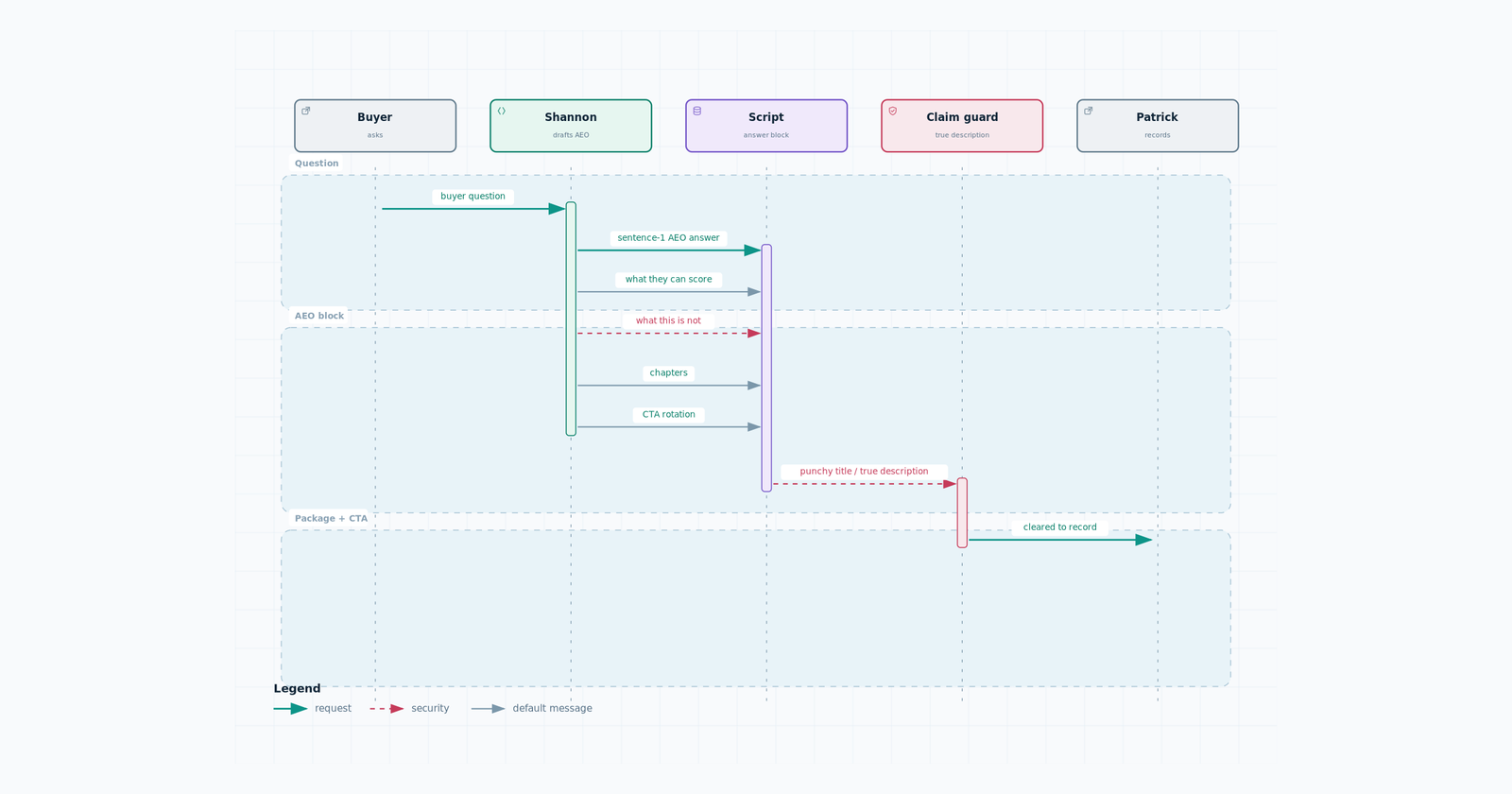
YouTube long-form is our primary long container. The recording packet + the AEO description are the long text you actually write every week.
Description order:
- AEO line: question + answer in sentence 1 (operational AI, unconfirmed/late PO chase — not internal offer copy)
- What they will be able to score or see
- What this is not
- Chapters = spoken beats
- Soft CTA from the rotation
- No price list unless it was in the script
Titles: 5 options, ~60 characters, role or system + one concrete claim. Avoid "assessment," "audit," "case study," guarantees.
An X article is optional later, not week one. Do not start a Substack.
Format 5 — FAS analog (not prompt packs)
Cole's piece treats prompts as assets. We do not sell prompt packs, writing courses, or "make money online from content."
FAS analog:
- Role-automation map — the artifact the CTA points at. You may draft map language when Patrick asks. You do not send maps.
- Edit brief — the spec you write before you cut (Module 8). You cannot cut what you cannot articulate.
Those are internal tools. They are not a fifth public content format in week one.
What you do not copy as FAS policy
Ship 30 for 30, Dickie Bush, course-revenue stories, 20 hours / 10,000-word flop as our metric, Substack funding or list stats, Typeshare/Gamma as required, "make money online from content," 100,000 Digital Writers, free Ultimate Guide funnels, "go viral with ease."
Pass bar
Pass bar
Same idea in X, LinkedIn, carousel outline, and AEO description. Share test on X and LinkedIn. Claim guard on all four. CTA from the rotation. You did not post.
What good looks like
Patrick Barbour
X — draft — he posts
Unconfirmed POs sit in email. The floor date is already a lie.
Patrick Barbour
X — draft — he posts
The agent drafts the chase. A named human still awards, prices, and promises the customer.
Patrick Barbour
LinkedIn — draft — he posts
Issuing the PO was never the hard part. Confirming the date is. Unconfirmed POs sit in email. The floor date is already a lie.
The split
Most of this coordinator posting is chase. Duty-weighted. Not a time study.
The hard no
The agent drafts the chase. A named human still awards, prices, and promises the customer. It does not approve the PO. Where does the date actually live on your desk — inbox, spreadsheet, or the ERP row?
What not-good looks like
Draft — do not ship
X — fail
Unlock AI in your stack 🚀 thoughts?
Draft — do not ship
X — fail
We saved a client 40% on expediting. Link in bio.
Draft — do not ship
LinkedIn — fail
Excited to announce our synergy in operational excellence. Book your Current State Assessment. RecStack + SearchNOW. Hashtag dump.
Hashtag dump. "Excited to announce." "Synergy." CSA/audit language. Price list. RecStack/SearchNOW.
Shannon exercise
Shannon exercise
Take this week's Ep1 packet (the one you wrote, not a prior week). Produce:
- One X post (Format 1)
- One LinkedIn atomic essay (Format 2)
- One carousel outline, 6-8 slides, paper/navy, few words (Format 3). If you have the Ep2 Archify PNG, use it.
- Five titles + the full AEO description (Format 4)
Same idea in all four. Share test on 1 and 2. Claim guard on all four. CTA from the rotation.
7. Thumbnails
Why this exists
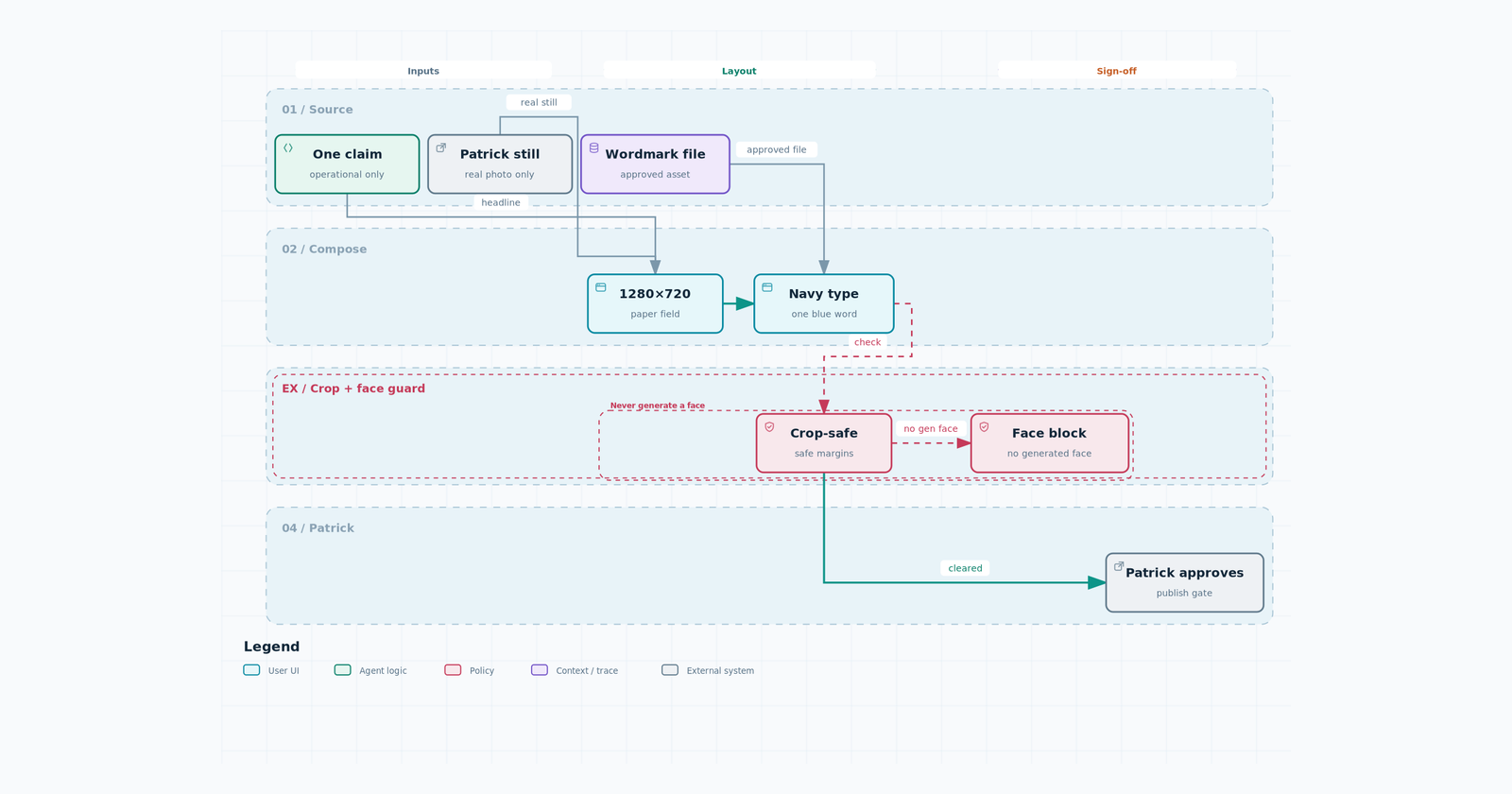
One operational claim on a 1280×720 frame. Match the live channel. Do not invent a new look.
FAL generates thumbnail art (blueprint, type field, operational still). Not his face. Not the logo. Composite Patrick from a real still. Never FAL-generate his face.
Work steps
- 01
Lock one claim from the packet. Examples of the type: "It does not approve the PO." "Not another dashboard."
- 02
Match the live template (below). Paper/white field, navy type, one electric-blue word.
- 03
FAL for art only. Composite his face from a real still. Wordmark: approved file only. If you do not have it, ship without a logo and say so.
- 04
Crop-safe: claim and face out of lower-right duration badge and left 10%.
- 05
Three comps, same claim, three crops. Mark crop-safe boxes.
- 06
He approves the frame. You never upload.
Live template (lock)
- Paper/white field, navy type, one electric-blue word
- Type left, Patrick still on the right over a light blueprint
- Stacked all-caps punch, one bright-blue word
- Navy footer bar
- Crop-safe: claim and face out of lower-right duration badge and left 10%
- Patrick is a real photo cutout. Composite from a real still. Never FAL-generate his face.
- Wordmark: approved file only. If you do not have it, ship without a logo and say so.
On the frame: one claim. No company name, price, or guarantee.
Pass bar
Pass bar
1280×720. Live template. Real still, not a generated face. One claim. Crop-safe marked. He can approve a frame without a new art direction.
What good looks like
It does not approve the PO
Issuing the PO was never the hard part. Confirming the date is.
Type left. Real still right. One electric-blue word. Navy footer. Crop-safe boxes marked. FAL made the blueprint, not the face.
What not-good looks like
FAL-generated Patrick. Typeset logo. Company name on the frame. Guarantee in the punch.
"AI Will Transform Your Procurement Forever" as the thumb. New art direction that does not match the live channel.
Shannon exercise
Shannon exercise
Three thumbnail comps for this week's Ep1 claim. Same claim, three crops, crop-safe boxes marked. Composite his face from a real still. Never generate it.
8. Long-form edit
Why this exists
Make the episode watchable for a VP of ops. Not cinematic for its own sake.
Patrick records in Focus C. You cut. Codex stays out of the edit. Diffusion when he turns it on. Hyperframes = motion and thumbnail stills, not the recorder.
If Diffusion is not on yet: same brief, cut in the editor you already use. Same pass bar.
Work steps
- 01
Write the edit brief before you touch the timeline. The brief is the plan. The cut answers it.
- 02
Focus C file is A-roll. Never generate Patrick's face. Never generate the wordmark.
- 03
Cut for the first 20 seconds: promise on screen. Kill throat-clearing, restarts, "as I mentioned."
- 04
Hold on-screen JD board (Ep1) or Archify path (Ep2) or guest answer (Ep3).
- 05
Overlays: FAS paper/navy, one electric-blue word. Do not cover his head.
- 06
Return cut + punch list. He approves. You never upload.
Brief first
Source folder: (Focus C file)
Episode type: teardown / talking-head-demo / podcast
Target: 12-15 min, 1920×1080 YouTube
First 20s: promise on screen
Kill: throat-clearing, restarts, "as I mentioned"
Keep: scored JD board / Archify path / guest answer
Overlays: FAS paper/navy, one electric-blue word. No Diffusion brand fallback.
Then: 2-4 vertical shorts from this file, self-contained 20-45s
Handoff to Patrick: cut + punch list (what you took out, what still needs a pickup). He approves before upload. You never upload.
Diffusion (when Patrick turns it on)
Live sources: Casey, 28 Aug 2026, Konstantin, 28 Aug 2026, skills at https://github.com/diffusionstudio/skills, product at https://diffusion.studio.
The point: the edit is code. Agents lose context and spit out files you cannot change. Diffusion keeps the timeline as JSX you can modify.
Install (only when he says the tool is on): npx skills add diffusionstudio/skills -g
Two skills: /editor (cut — your job) and /watch (understand / find clips).
Where it runs
- Windows: browser, https://app.diffusion.studio. No Windows desktop app yet.
- Agent /
dapipath: macOS 12+ Apple silicon (M1+) only. Do not assume a Windows PC can rundapi. Do not go looking for a Mac until he turns that machine on. - Do not clone the editor. Do not install the Mac app until he says your machine is on.
Loop (FAS adaptation — do not copy their 9:16 talking-head example as our look)
- Focus C file is A-roll. Never generate Patrick's face. Never generate the wordmark.
- Probe the file.
- Waveform (audio) + filmstrip (video). Cheap overview. Where it is loud, where the picture changes.
- Transcribe with word-level times. That is what you cut on.
- Prefer transcribe over
listen.listencosts credits. Do not quote credit prices. Uselistenonly when you need non-speech audio or a clip hunt that transcript cannot do. - Lay A-roll as JSX. Spine first. Nothing else until the spine holds.
- Long-form scene is 1920×1080, not their 1080×1920 talking-head example.
- Overlays next: JD board, Archify PNG, lower-thirds. FAS paper/navy, one electric-blue word. Text punctuates. Do not cover his head. Do not fall back to Diffusion's Inter-on-black hook as our brand.
- Captions last, after the cut and overlays are right, so they transcribe the finished audio at its final placement.
- If
dapiis actually on:checkthencapture. Export only when he says. A clean save is not a finished video.
Cut points
- Open on the first word. Dead air at the top dies.
- 0.3-0.5s between sentences. Enough to breathe, not to drag.
- Mid-sentence, butt the words. Never mid-word.
- Up to 0.8s trailing air on the way out. Do not chop the last word off.
Silence you keep lives inside the clip (sourceOut / next sourceIn), not as a hole in the timeline. A gap freezes or blanks the frame.
Shorts from the same project
1080×1920. Same JSX project as the long-form, not a second mystery export. Self-contained. Claim in the first 2 seconds. See Module 9.
Remotion
Casey bonus: Remotion skills with diffusionstudio/skills. Not week one. Do not install Remotion until he says.
If the tool is off
Same brief. Same cut points. Same punch list. Whatever editor you already use.
Hyperframes
Motion + thumbnail stills. Not the recorder. Not "hey frames."
If motion is needed, brief: focal subject, operational relationship revealed (not decoration), duration 3-8s, where it freezes for the thumbnail. Freeze on the human check when the story has one.
Pass bar
Pass bar
Brief exists before the timeline. Time-to-first-claim in the first 20 seconds. Punch list returned with the cut. Codex did not touch the edit. Face on screen is the recording, not a generate. You did not upload.
What good looks like
This is a real procurement coordinator posting. I am not naming the company. I am scoring the work.
Cut + punch list: killed throat-clearing, held the board at beat 3, pickup needed on the hard-no line. He can approve without guessing.
Same brief. Same cut points. Editor she already uses. No Mac-agent chase.
What not-good looks like
No brief. Codex in the timeline. Generated face overlay. Diffusion Inter-on-black as the brand. You uploaded.
"We skipped Focus C and used Hyperframes to record him." Hyperframes is motion, not the recorder.
Shannon exercise
Shannon exercise
After the first Focus C file: return a cut (or a paper cut list with in/out times if the tool is off) plus a one-page punch list. Time-to-first-claim in the first 20 seconds. Do not install Diffusion, Remotion, or a Mac app until he turns them on.
9. Shorts + native captions
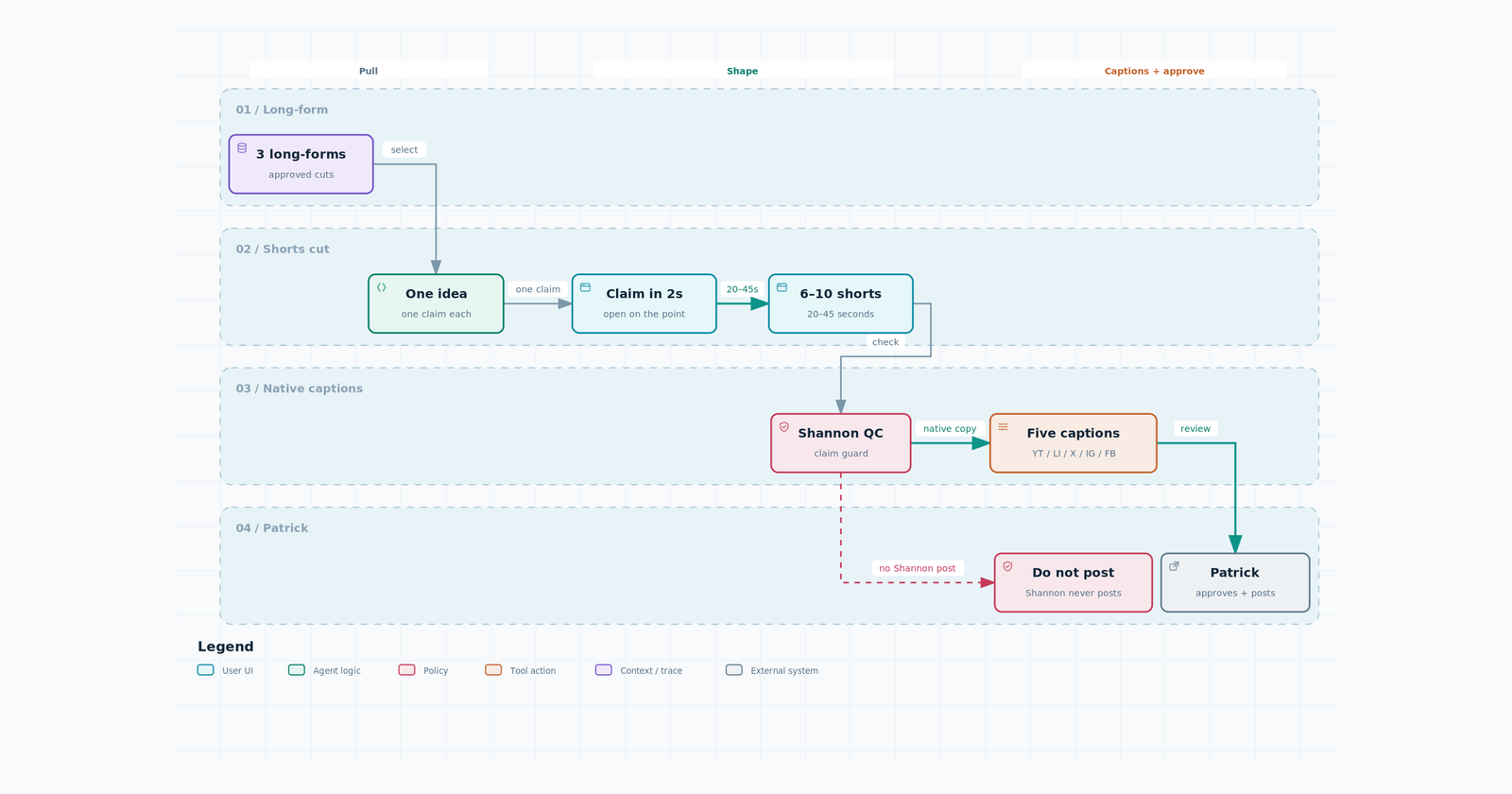
Why this exists
6-10 shorts from the three long-forms. One idea per short. 20-45 seconds. Claim in the first 2 seconds, on screen.
Platforms this pack names: YouTube Shorts, X, LinkedIn. Instagram and Facebook exist later. Do not write those captions this round unless he asks.
Work steps
- 01
Pull 6-10 moments from the three long-forms. One claim each.
- 02
Cut 20-45s. Self-contained. Claim on screen in the first 2 seconds.
- 03
Write native captions. Not one paragraph pasted three times.
- 04
YouTube Shorts: one line + long-form link when it exists.
- 05
X: one sentence, maybe two. First line is the claim. Share test.
- 06
LinkedIn: executive. One operational claim. Atomic-essay skills (Module 6). No hashtag dump. Share test.
- 07
Claim-guard every caption. He approves. You never post.
If Diffusion is on: shorts are 1080×1920 scenes in the same project as the long-form. Find the moment, lock in/out on whole words, then frame. Captions last.
Podcast-style clips (Ep3): the work is search. Transcript and waveform first. Prefer transcribe. A clip with no surrounding context has to stand alone.
Each short
- One claim in the first 2 seconds (on-screen)
- 20-45 seconds
- Self-contained. No "watch the full video" as the idea
- Native captions, not one paragraph pasted three times
Pass bar
Pass bar
A VP of ops would stop. Claim in 2 seconds. 20-45s. Self-contained. Claim guard on every caption. Share test on X and LinkedIn. You did not post.
What good looks like
One claim in the first 2 seconds. 20-45s. Self-contained. On-screen: "It does not approve the PO." Caption is native to the platform.
Patrick Barbour
X — draft — he posts
Unconfirmed POs sit in email. The floor date is already a lie.
Patrick Barbour
X — draft — he posts
The agent drafts the chase. A named human still awards, prices, and promises the customer.
What not-good looks like
"Watch the full video" as the idea. 90s. Three ideas in one cut.
Same hashtag dump on YouTube, X, and LinkedIn. "Unlock AI in your stack 🚀 thoughts?"
Shannon exercise
Shannon exercise
From the first long-form (or from the packet beats if the file is not in yet — mark those as caption practice, not cuts): three short ideas, one claim each. Write YouTube Shorts + X + LinkedIn captions for one of them. Share test the X and LinkedIn. Do not paste one caption three times.
10. X + LinkedIn strategy
Why this exists
FAS adaptation of Mubbu. Structure only. Posts FROM episodes, not a 7-10 topic mill. Mon-Fri.
Live sources: 29 Aug 2026, 3 infographics and 28 Aug 2026 (article: https://x.com/i/article/2093352938995404800).
You draft. You flag snipes. He quotes. He posts. You never post.
Work steps
- 01
After packets exist, list the beats that become X posts and LinkedIn atomics. See Module 6.
- 02
Write those drafts from the packet, not a blank page.
- 03
Weekday VOC / competitor watch: flag zero or one snipe, or write "none this week."
- 04
For a snipe: one line on why he has the right to talk, and which pillar it ties to. Do not draft the quote in his voice until he asks.
- 05
LinkedIn snipe = screenshot + commentary (he posts; you draft the commentary).
- 06
Queue Mon-Fri. No Saturday/Sunday snipe job unless he adds a weekend.
- 07
He approves. He posts. You never post.
Keep (mechanics, not their business)
Interest graph. X and LinkedIn distribute on what people already care about, not only who already follows. The graph reads keywords, accounts, topics, styles, likes, replies, reposts, shares, profile visits. Follower count still matters. A second door is people who never followed Patrick but keep engaging with coordinator-chase, late POs, industrial ops, and operational AI.
Write so a VP sends, quotes, replies, saves, or dwells. Stronger than a like. Reports, mutes, blocks, "not interested," and low dwell work against us.
4-5 pillars with who / what / when / where / why / how. Personal-story pillar stays. Repetition with direction.
FAS pillars (not Mogul's):
- Role teardowns
- Agent systems in existing tools
- ICP conversations / operator reality
- Patrick's story and lessons, founder not guru
- What this is not
Snipes. A conversation already has attention. Quote it. Add an opinion, a story, or a lesson. First line = why he has the right to talk. Tie it to a pillar.
- You flag (weekday VOC / competitor watch). You never post.
- He quotes.
- LinkedIn snipe = screenshot + commentary (he posts; you draft the commentary).
- Cadence: most of the week is the three episodes + shorts. Snipes are the rest. Mon-Fri only unless he adds a weekend.
Review: winning topics, hooks, formats, profile visits, follows, map requests. AI drafts. Founder thoughts stay in the packet.
X / LinkedIn posts are generated from the three YouTube episodes. Beats → native posts (Module 6). Not a separate 7-10-topic factory. Not a Saturday/Sunday snipe job.
CTA on his posts (rotate, never skip): (1) engagement question tied to that post (2) role-automation map (3) $1,500 / 90-minute workshop, founder angle. Not a calendar dump of the 20-minute discovery.
Do not copy as FAS policy
$1,000,000 system, 1,923 pieces/month, 60+ accounts, 45 minutes a week, Saturday/Sunday snipe job, PBHQ, Mogul prices, Ryan Deiss 1-3 likes, 100k/186k view claims, "I did X and made $Y" hooks, Claude+Playbook stack.
Pass bar
Pass bar
Every X/LI draft traces to an episode beat or a flagged snipe. Share test. Claim guard. CTA from the rotation. You did not post. Snipes are weekday unless he adds a weekend.
What good looks like
Shannon flags a public post about late material. First line of Patrick's quote is why he can talk (operator / founder of FAS). Ties to pillar 2 or 3. She does not post it.
Patrick Barbour
X — draft — he posts
Unconfirmed POs sit in email. The floor date is already a lie.
Patrick Barbour
X — draft — he posts
The agent drafts the chase. A named human still awards, prices, and promises the customer.
What not-good looks like
Shannon posts it herself. First line is "Great point!" Weekend snipe job as policy.
Seven to ten topics that never appeared in a packet. "Unlock AI in your stack 🚀 thoughts?" "We saved a client 40% on expediting. Link in bio."
Shannon exercise
Shannon exercise
From this week's three packets (even before cuts exist): list the beats that become X posts and LinkedIn atomics. Flag zero or one snipe candidate from a live public post, with one line on why he has the right to talk and which pillar it ties to. Or write "none this week." Do not draft the quote in his voice until he asks. You still do not post.
11. Performance she monitors
Why this exists
You watch qualified attention, not a view-count contest. You ping Patrick only on a real hit. You do not invent targets.
Work steps
- 01
Track the list below. No invented numbers. No "we need X views."
- 02
Once a week (Friday block): a short note if anything actually moved. What moved, which pillar, which container (long-form / short / X / LinkedIn), what you would restate next.
- 03
Ping him only on a real hit (list below). Do not ping on a like count. Do not ping on "it got views."
- 04
Claim-guard the note too. No invented metrics.
Track
- Winning topics
- Winning hooks
- Winning formats
- Profile visits
- Follows
- Map requests
- Which short / which platform moved
Qualified attention > view counts. A VP who saves, quotes, or asks for the map beats an empty reach spike.
No invented targets. No "we need X views." No Mogul volume numbers.
Ping Patrick only on a real hit
- Someone asked for the role-automation map
- An ICP executive engaged (comment, quote, reply that is actually the buyer)
- A guest said yes
How you report
A short note, not a dashboard novel. What moved, which pillar, which container (long-form / short / X / LinkedIn), what you would restate next. Claim-guard the note too — no invented metrics.
Pass bar
Pass bar
The note is short and true. Hits are real hits. No invented ROI, view targets, or Mogul volume. You did not ping him about likes.
What good looks like
LinkedIn atomic on "it does not approve the PO" got a save from a VP-shaped comment. Pillar 5. I would restate the hard-no next week. No map request.
Someone asked for the role-automation map. Here is the comment. I did not send the map.
Nothing qualified moved. No ping.
What not-good looks like
"We need 10k views." Invented ROI. Ping on likes. Mogul monthly volume as a target.
She sent the map because someone liked the post.
Shannon exercise
Shannon exercise
Write this week's performance note in five lines, or write "none this week." If you think something is a hit, say which of the three ping rules it matches. If it matches none, it is not a ping.
12. First 10 days + daily 15s
Why this exists
Do not teach the whole TOC on Friday. Sequence the work. Daily 15 minutes, same agenda. One job, one blocker, one draft.
Do not treat a prior week's pack as the model. Build from this week's JD and this week's packets.
Work steps (first 10 days)
| Day | You do | Bring to check-in |
|---|---|---|
| Thu | Read this + the visuals that exist | — |
| Fri 12:00pm CT | Q&A with Patrick | Written answers to section 0 |
| Mon | Modules 1-3 (factory + day-to-day + Ep1). Copy (Module 6) on the same packet | Ep1 one-pager + start of the recording packet. Pillar named. Snipe-or-none |
| Tue | Finish Ep1 packet. Start Module 4 Ep2 packet (framework, not a prior week). Module 6 X + LinkedIn from Ep1 | Full Ep1 packet. One X post + one LinkedIn atomic from it |
| Wed | Module 7 thumbs on that Ep1 claim. Module 4 Ep2 Archify prompt filled | 3 thumbnail comps, crop-safe marked. Carousel outline or "waiting on diagram" |
| Thu | Module 4 Archify for Ep2. Edit brief if a recording exists (Module 8) | Archify HTML + 2400×1260 PNG. Edit brief or "no file yet" |
| Fri | AEO description (Module 6 Format 4). Module 9 caption practice from beats | 5 titles + full description, AEO sentence highlighted. 3 caption sets marked practice vs cut |
| Next Mon | Module 5 Ep3 | Host packet from a card he gives you, or talking-head substitute packet. 8-12 questions. Exact referral line |
| Next Tue | Module 8 Diffusion only if the tool is on; else skip. Outbound QC is later | Brief + punch list, not a tool tour. No Mac-agent chase |
Daily Mon-Fri: 15 minutes. One job, one blocker, one draft.
Daily 15-minute check-in agenda
Same agenda every day. Skip status theater. If nothing is in draft, the check-in is the work session.
- What shipped as a draft since yesterday?
- Claim-guard fail? Quote the line.
- One blocker. Patrick decides. You do not wait on a bot.
- Tomorrow's one job.
Pass bar
Pass bar
Friday answers exist. Monday packet is from a fresh public JD, not a prior week. Each check-in has one job, one blocker, one draft. You did not wait on a bot. You did not post.
What good looks like
Fresh public JD, company unnamed. Ep1 packet started. One X + one LinkedIn from those beats. Snipe-or-none. Pillar named.
Draft shipped: Ep1 do-not-say list. Fail quoted: none. Blocker: posting IDs the shop if I keep the city — I stripped it. Tomorrow: finish the board.
Host packet from a card he gave, or substitute packet. Exact referral line in it.
What not-good looks like
She copied last week's packet because it was handy. Check-in is status theater. No draft. Waiting on a bot.
You try to learn Diffusion, Guest, shorts, and outbound on Friday. Lock never holds.
Shannon exercise
Shannon exercise
Bring Friday's three written answers. Then run the daily 15s for real: one job, one blocker, one draft. Do not arrive with a status novel and no page.
Later lane (parked)
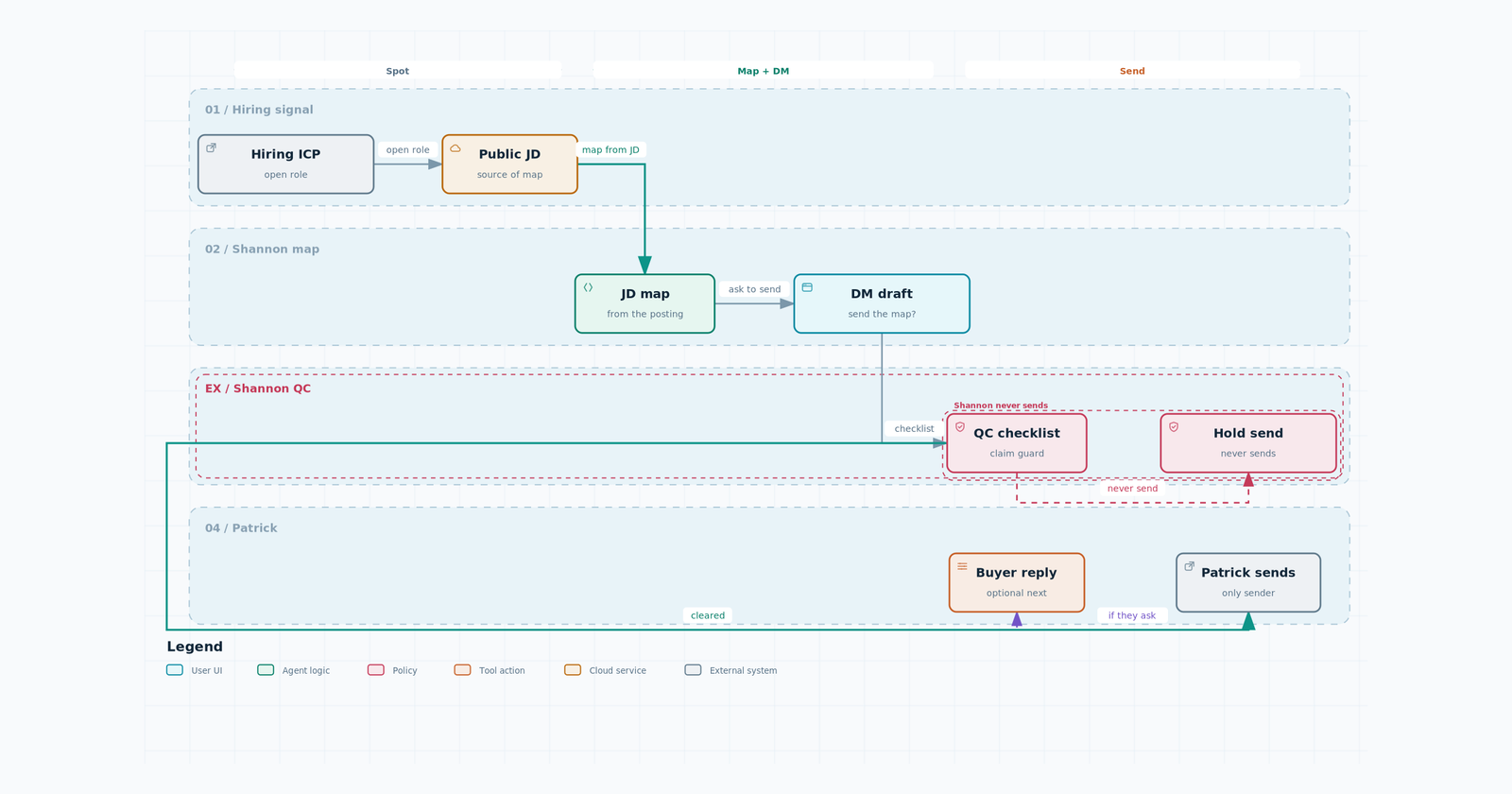
Outbound QC is a later lane. One line: do not hunt accounts, draft DMs, or QC outbound batches until Patrick opens that lane. Ignore this diagram as work until Patrick opens it.